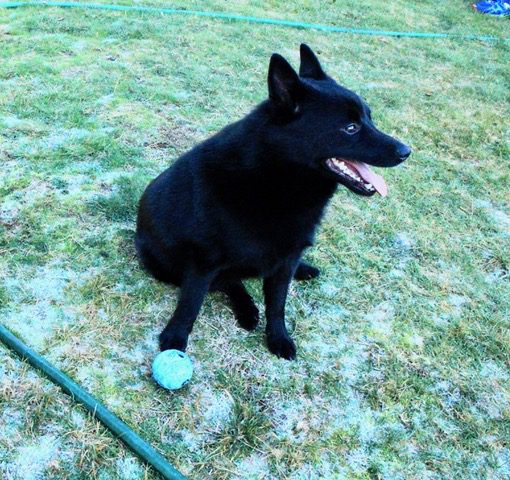
Cord ball. Only tennis players know the term. That’s when a tennis ball hits the top of the net during play and trickles over and lands fair and square on the opponent’s side. Often, although not a rule, players hold up their hand as though to apologize.
Whenever Jeff and I played tennis, we never used a net. He hit the ball and I chased it. It wasn’t until my woman stopped the fun, saying that the fibres in the tennis ball were dangerous for my teeth. Apparently, it’s true. Fibrous fuzz can wear down teeth and could cause intestinal blockages. What? Is that why I got constipated?
But that’s not why I am talking about Cord ball. Last week, a player named Ostapenko got mad at Townsend after she got beat in a game. She called the black tennis player “uneducated”, a code word. She shook her hand but immediately wagged her finger. “You bad”. Jeff and I looked at each other and laughed. Sore loser or what, I asked. Well, put a tennis ball in your mouth and see what happens then.
There are too many sports terms to know. Like, calling a zero score Love, or having to wear white at Wimbledon, or tweener, or moonball, or poaching, or daisy cutter. Although there are terms I like and understand, like Bagel, or Breadstick (my favourite) and dirtballer, are all terms part of my vast vocabulary.
But Cord Ball takes the cake. And why did the Ostapenko girl really get mad?
On social media, Ostapenko was accused of racism. Interestingly, Townsend did not throw down the race card. She merely suggested that sometimes emotions rise and players can be given to outbursts they later regretted. Like when the Russian player, Sabalenka, lost to Coco Gauff. That match was earlier this year at the French Open. Sabalenka said that “She won the match, not because she played incredible, just because I made all of those mistakes…” Wha, wha…
Crybaby or racist? You tell me. Not that I am a good judge, being a black Belgian dog. Perhaps I am biased. Jeff and I watched that match. It was amazing. Coco was amazing, strong, consistent, unemotional and focused. Whereas Sabalenka, always the drama queen, wore her emotions without any concealment. In fairness, Sabalenka apologized to Coco, saying she “absolutely regrets” the “completely unprofessional” comments. This tells me that racism is not at play. Crybaby, maybe.
I love watching tennis with Jeff because he always makes popcorn for us. I looooove popcorn. And he will answer any of my questions. All I have to do is look at him and he knows what is on my mind. I suppose it is because he wrongly thinks that I have six coffee beans for brains. So, I asked him his opinion about race and sports.
He told me about Arthur Ashe and Althea Gibson, two of the first Black athletes to break the colour barrier in tennis. Ashe faced many obstacles, including being barred from tournaments early in his career because of his race. In 1969, despite being recognized as one of the best players in the world, he was denied a visa to compete in the South African Open. In 1997, his legacy was honoured when the US Open named its main stadium after him. Ashe was also the first Black player to win the tournament.
Althea Gibson rose to tennis stardom in the post-war era. In 1956, at 29, she became the first Black woman to win the French Open. The following year, she captured Wimbledon and the US Nationals, the forerunner of the US Open, repeating both victories in 1958. Unlike today’s champions, she reached her peak later in life, after years of barriers under Jim Crow segregation that kept Black athletes out of major competitions.
Gibson was often barred from clubhouses and hotels, relying instead on friends and family for accommodation. A gifted all-around athlete, she later turned to golf, joining the LPGA Tour in 1964 at age 37. She again faced restrictions that kept her from renting hotel rooms or entering clubhouses, but she continued to compete at the highest level.
When the Williams sisters broke through, it was a different story. Over the past 25 years or so, both Venus and Serena have become superstars. Not only did they shatter records, but they seemed to have shattered the racial spin in tennis, replacing it with topspins, backspins and powerful serves. At 45, Venus played in this year’s US Open and came close to advancing. The colour divide, while not as bad as it has been in the historical context, is still there, though. They have both held their heads high, despite the sometimes cantankerous behaviour of their father. You have only to look up what happened at the Paribas Open in 2001.
When I told Jeff what I learned in my research, his response seemed flat. “Yup. It’s what I told you”. I gave him the usual stare. No response. He hadn’t told me much and just gave me two names. The research was up to me. And I’m a journalist, dammit. I did some digging.
With my head hanging low, just when I was feeling like a black furry kid, neglected and ignored, I suddenly felt the warmth of his arm around my furry neck as he pulled me close to him in only the way that he does. I knew at that moment that love breaks any barriers we may feel, even at low points in our day. He began singing to me his favourite Boyz Jones song that ends with the phrase, “He’s the best dog in the whole-wide-world, BOYZ JONES!”
There’ll be no Cord Ball in this house. And the score is Love/Love.