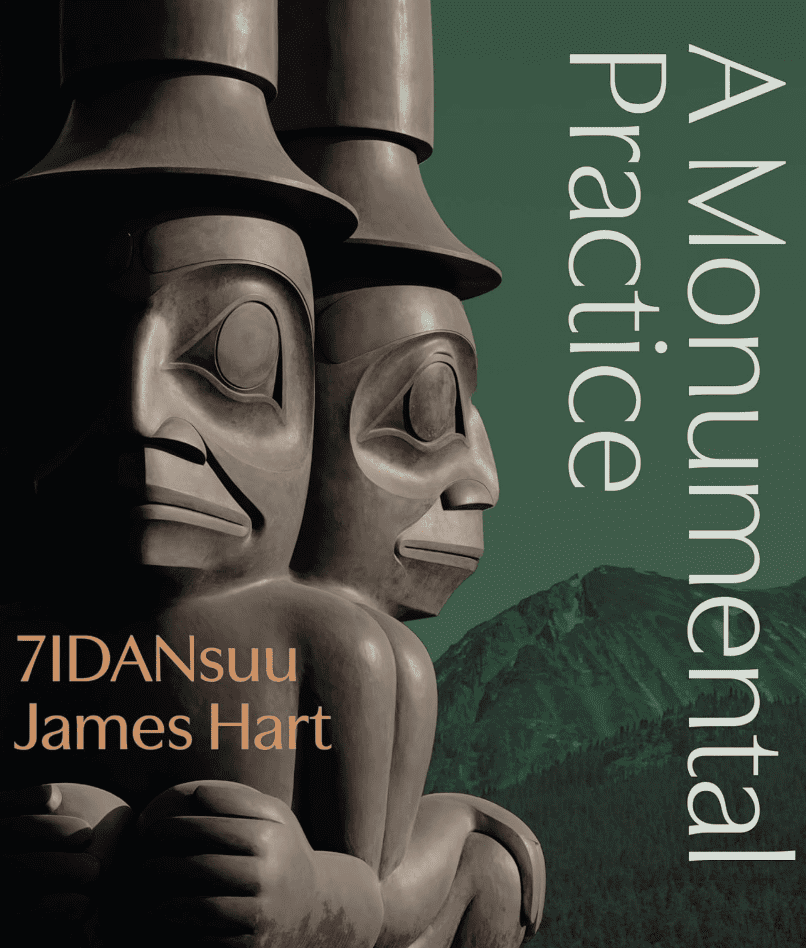
The first book of distinguished sculptor and artist James Hart of Masset, BC, was launched at the Bill Reid Museum earlier this month. At 248 pages, lavishly designed and filled with words and colourful images that illustrate Hart’s immense and prolific output, it is a treat for the senses.
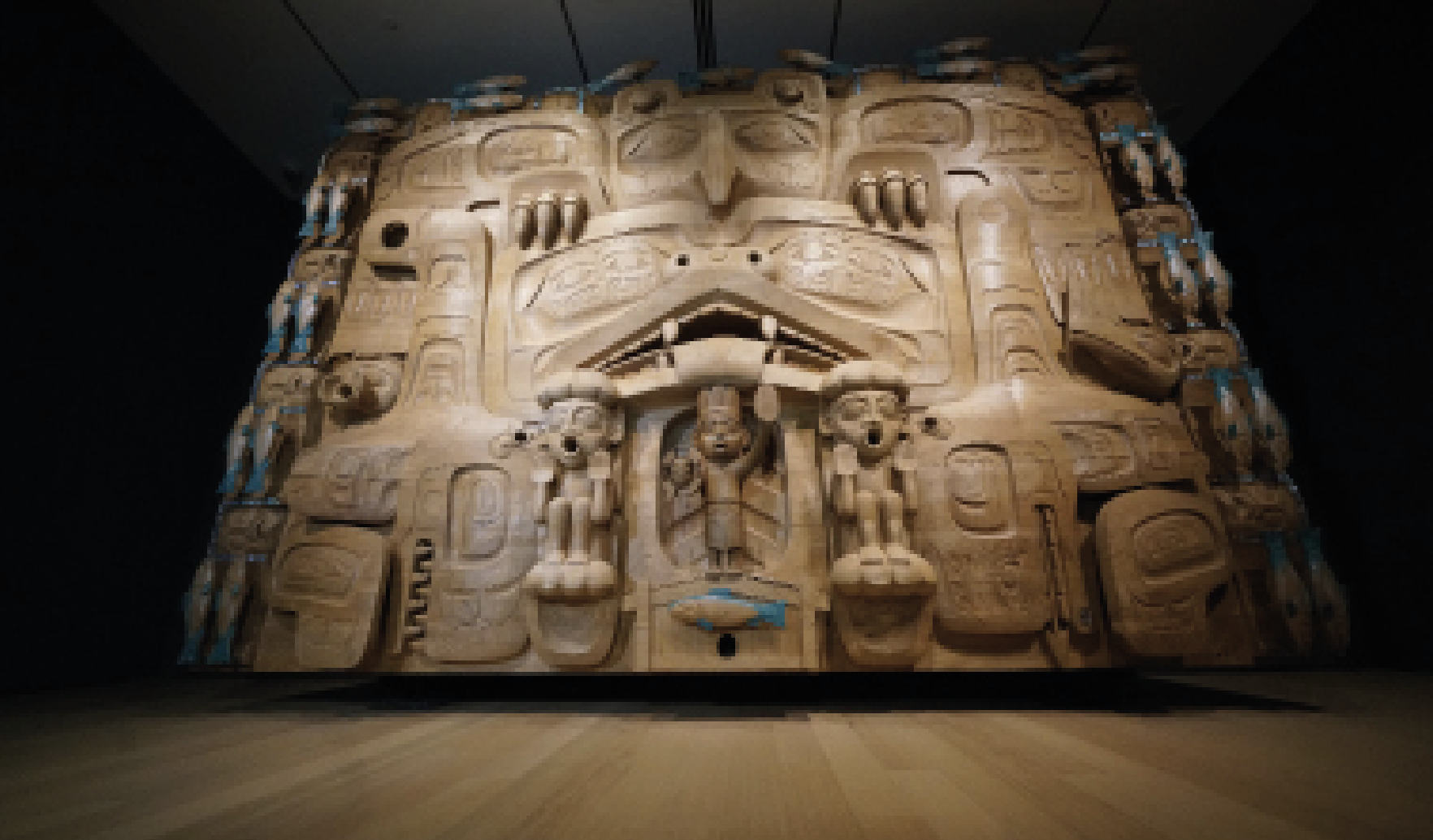
The spark that ignited curator Curtis Collins’ deep interest in Haida art occurred in 2018 during the installation of Hart’s The Dance Screen, Scream Too. The carving featuring crests of shamans and salmon is a key feature of the masterpiece work and makes a penetrating socio-political statement on the future of salmon. Before the ceremony to breathe life into the sculpture, James formed a prayer circle and invited the newly appointed curator of the Audain Museum to join the ceremonial blessing.
Collins told the packed audience gathered at the Bill Reid Museum that, “As a curator of thirty years, I was touched by that moment.” Two years later, Hart’s lifelong friend Lindsay Eberts suggested Collins consider writing a book about his Haida friend. Curtis was intrigued and began researching Hart’s works. He was enthralled and inspired by his boss Michael Audain’s vast collection of Hart’s works.
As Audain explains in his foreword to the book, “I was not entirely surprised to learn that this is the first book focusing on James Hart’s work as an artist. After all, his sculpture isn’t easily confined within the walls of a gallery that might produce an exhibition catalogue. Sculptors, particularly those who work on a monumental scale, are different than those who work in two dimensions.”
Audain notes that Hart’s oeuvre will communicate his messages to generations to come. “I venture to say that just as we are enraptured with works of bronze and stone created thousands of years ago in ancient Greece, future generations will be enriched by the work of this master Haida artist.”
Writer and explorer Wade Davis weighs in with a lengthy essay recounting the history of Haida Gwaii. He points out that smallpox and other diseases had nearly wiped out the Haida population. Numbered among the survivors were artists, fishermen and the noble classes. Among these men were Hart’s ancestors, namely Albert Edward Edenshaw and the famed carver Charles Edenshaw. Each held the Haida chief name of 7Idansuu. In 1999, James Hart inherited this historical name.
Chapter three of the book brings us James Hart’s voice. He talks about his early life, time spent living outside Old Massett, as his mother Joan Thelma Rose White had married a non-Indigenous man named James Lyle Hart. Under the federal Indian Act, the colonial powers stripped an Indigenous woman of her rights to live on the reserve. But Joan was resilient and strong, never fully accepting the colonial rules. Hart’s chapter is a story told from a deep reservoir of reverence and is guided by factual and genetic memory. Much of Hart’s gift is that of the storyteller with depth, pride and integrity. His story is filled with the kinds of Indigenous irony that evades non-Indigenous intellectuals and art critics. When asked how long it has taken him to become a master of the art, he quips, “10,000 years.”
Chapter four is an extraordinary trip across 52 years of a carver’s life. Written eloquently with a strong attention to detail, Curtis Collins takes us on a journey of a man who fell in love with an art form he only knew from a distant place.
Collins describes himself as an Anglo-Franco-Canadian from Cornwall, Ontario, who had only a basic understanding of Haida art learned in museums. He qualifies the book as a curatorial study based on a close examination of Hart’s large-scale works and photographs residing in museum collections across North America and Europe.
Collins spent time talking to the Haida arts community. He listened, observed and learned about how James Hart grew to be a teacher to numerous young artists, how Hart became a leader of the Eagles, the Staastas of northern Haida Gwaii. Collins’ first-hand research paid off. He was invited to and observed Chief 7Idansuu in his most intimate moments as a chief when he attended the memorial feast for his and Rosemary Hart’s dear son, Carl, who passed unexpectedly in 2015.
Moreover, Collins addresses one of the key issues at the heart of contemporary Indigenous art. It is what Audain identifies as a “suggestion that his (Hart’s) artwork is simply a pastiche of that completed by his ancestors.” Hart bristles at the suggestion. “The people saying that don’t understand that, in many subtle ways, I’ve innovated on the traditions of the Elders. But, of course, you’d only realize it if you were very conversant with Northwest Coast art-making traditions.”
Indeed, as Wade Davis further writes, “as every work celebrated in this book affirms, (Haida art) ranks among the highest aesthetic expressions of humanity. Playing with words to relegate it to ‘craft’ as opposed to ‘art’ is to deny its place at the very heart of Haida social, spiritual and political life.” Referring to commissioned totem poles, Davis writes, “They are lodestones of power, the axis mundi of a people, towers of strength that celebrate and anticipate the ongoing struggle of the Haida to reclaim a stolen legacy.”
In this massive overview of Hart’s monumental practice, Collins curates 19 of Hart’s creations that range from the 1970 Dogfish Screen to the 2023 Tllgidgaaya Carl Hart Memorial Pole, and many creations in between. Countless photographs of the works, archival family photos and related works round out this massive overture of sculptural masterpieces.
The final chapter of the book, the afterword, is a surprise appearance and a beautiful tribute by Hart’s son Gwaliga Hart. A poignant and poetic essay, erudite and clear, Gwaliga grew up around the monumental structures.
As children, Gwaliga and his siblings were constantly on the go. His mother, Rosemary Hart, was a flight attendant and her flight lessons earned her wings.
“My memories are of being in a curious landscape, swinging an adze on the long dorsal-finned Whale Killer Pole at two and a half years of age, exploring waterside garden paths among the former summer home of King Gustav V in Sweden, of all places. Then back home on the Northwest Coast, either on Haida Gwaii or on British Columbia’s southern coast.”
Gwaliga reaches deep into his dual heritage. “Dad was from Haida Gwaii, an ancient lineage, and Mum was from North Vancouver coming from an old and connected Vancouver family. Like some type of love medicine remedy, their blended offspring seemed to symbolize a type of reconciliation long before such a thing was announced as a national topic.”
As a young and budding carver, Gwaliga knows that for his father the artist, 7Idansuu’s depth of understanding runs deep and that innovation is his wings too.
“He told me poles were his backbone. There’s a beautiful word in Xaad Kil (Haida language), ‘Ts’uuwii,’ which means ‘backbone or spine’ and the ‘heart of a tree.’ It also means ‘melody of a song’ and the ‘warp of weaving.’”
Check your local bookstores for this literary treasure.