December is here, and it heralds the end of our calendar year. The seasons turn ever onward in their eternal cycle, so when the equinoxes and solstices occur, we have a chance to slow down and reflect. Where are we in the seasons of our life?
The winter solstice occurs on December 21, 2025, for us here in the northern hemisphere. It marks a time when we are at our maximum tilt away from the sun in the north. A slight progressive shift in our orientation towards the sun plunges the northern parts of our hemisphere into ice and darkness, while the south flourishes in the heat and light of summer.
At this time of solstice, we are in the deepest of the darkness. I ask that you pause and reflect. What is being made clear to you in the dark of night? What parts of you are asking to be grieved and released? What parts of you seek the light most? What seeds will you plant and nurture in the light of the months to come?
Grey winter days and long nights of sprawling darkness are not just for exploring our inner worlds. If we venture out into the darkness, we can find light. When the clouds part between storm systems, or when the cold north wind blows, the skies can reveal a tapestry of jewels hanging in the sky.
At times I have questioned the wisdom of writing a column about stargazing when we live in a place so rainy and overcast. Yet, when the sky is clear and you can glimpse infinity, I am reminded why. We live in a place so far from the lights of the cities, a place where the sky can be truly dark. Humans these days can live their entire life without seeing the true beauty of these constellations that shine for us so clearly here.
If you intend to spend your Decembers in the cold, beautiful north, you may as well learn some of the constellations that paint the sky in light this time of year. I hereby challenge you, reader, to go out when the sky is dark and clear and find the constellations that I mention in this column.
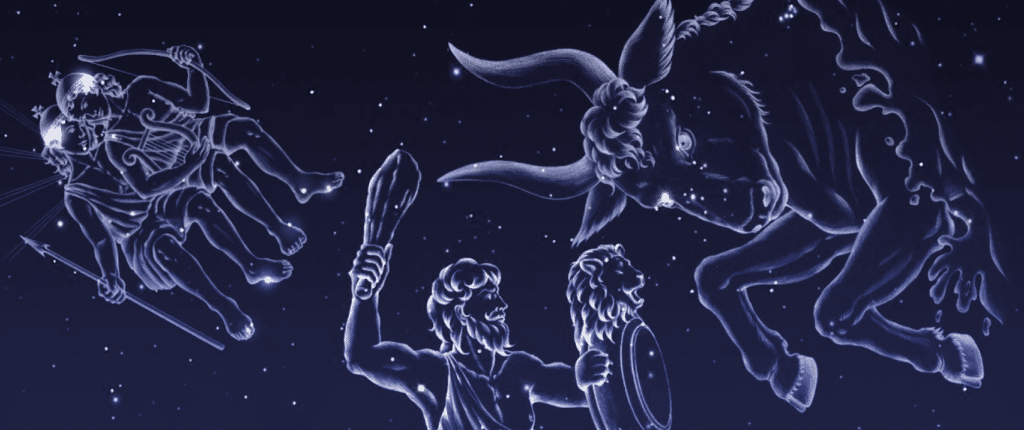
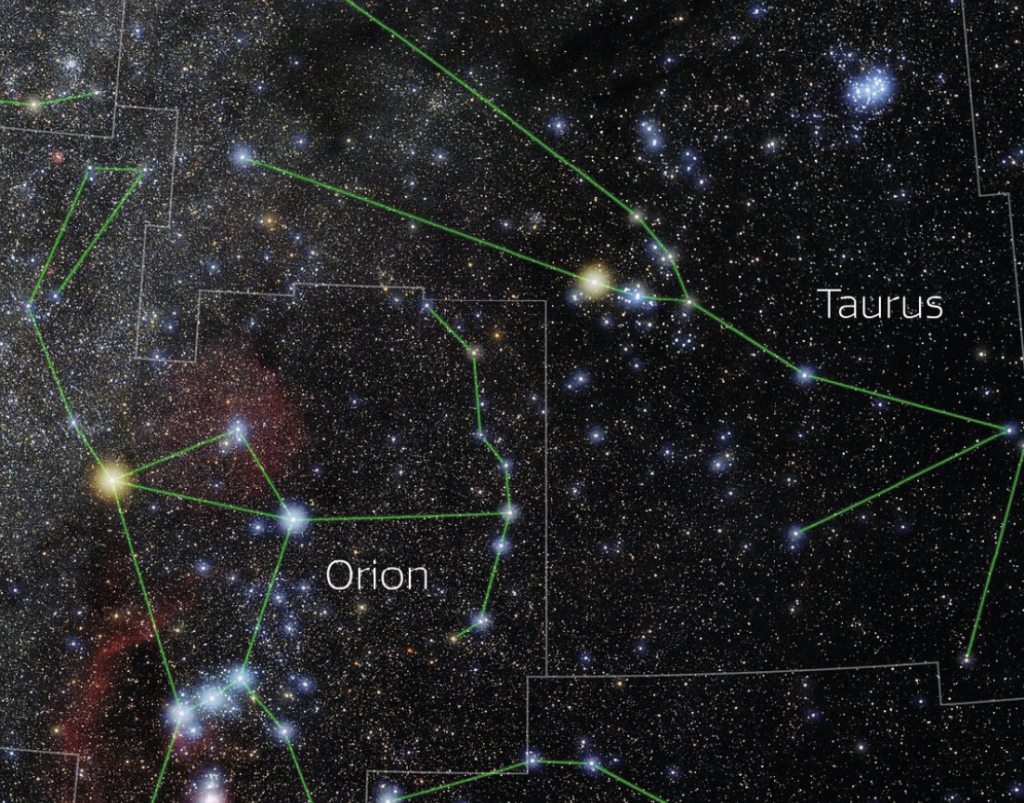
Orion, “the Hunter,” is a well-known constellation, and for good reason. With bright stars that stand out in the sky and a belt that even city slickers know, it should be easy for you to find on winter nights. At solstice time, Orion will be fully visible above the horizon by 8 p.m., meaning any late evening dog walks or causeway runs could result in a glimpse of this figure.
Two bright stars, the red supergiant Betelgeuse and the mysterious blue Bellatrix, form the shoulders. The three stars Alnitak, Alnilam, and Mintaka form the infamous Orion’s Belt that gives Orion his iconic snatched waist and that hourglass figure. Saiph and Rigel form the lower limbs of this hunter, with Rigel being the brightest star in the constellation.
Rigel (pronounced “Rye-jull,” from the Arabic “al-rijil,” meaning foot) is a blue supergiant star and is considered to be the seventh brightest star in the celestial sphere. However, it is a variable star, which means that its brightness as it is perceived on Earth can change over time.
Orion has many other distinct features that can be observed. His blade, hanging beneath the belt, is home to the Orion Nebula, which is visible to the naked eye. His shield can be seen as a crescent of stars on his western side, and his eastern side has an outstretched arm holding a club.
Orion has some well-known companions next to him that I am sure you have heard of, Gemini and Taurus. Perhaps you identify as a Gemini or Taurus, but have you identified these constellations in the sky?
Gemini, “the Twins,” constellation is currently highlighted in the heavens, as the bright planet Jupiter is hanging out with the twins over this season. Look for a stable, bright light in the sky, brighter than any star, and you will find the planet that is named after the Roman god of the sky.
Gemini is a constellation with a clear form. The twins look like stick men, with stars at their heads and major joints. See the attached image and try to make out the twin figures. Pollux and Castor are the names of the stars that form the heads of these twins, with Jupiter being closest to Pollux at this time.
Taurus, “the Bull,” is our other zodiacal constellation found close to Orion. This constellation is depicted as a bull’s head facing the brave hunter. Aldebaran is the brightest star in this constellation, a bright red supergiant star that is known as the “Eye of the Bull.”
If you find this Aldebaran, you will see a concentration of dimmer stars that form a V shape. I call this the mystic V, but their official name is “the Hyades.” They are the nearest open star cluster to Earth, at 153 light years away. If you follow each prong of the V, they will meet two stars, Elnath and Zeta Tauri. These are the horns of Taurus. Elnath is the brighter star and is also considered to be part of Auriga.
Auriga, “the Charioteer,” is one of my favourite constellations. It appears as a round, irregular polygon shape, highlighted by the bright golden star Capella. Meaning “Little Goat” in Latin, Capella is the third brightest star in the northern celestial hemisphere and the sixth brightest overall. Additionally, at our latitude it is considered to be a circumpolar star, meaning that throughout the entire year it never sets below the horizon, though it is often blocked by clouds, trees, or mountains in the summer months.
I hope that you can look up into the night skies this winter and find some of these constellations. Some may be old friends, or perhaps new faces you will meet for the first time. During this period of solstice reflection, remember these words of advice that were passed down to me from my great-great-great grandmother: “You cannot get mad at your ex for being a stubborn Taurus or a two-faced Gemini if you cannot even find those constellations in the sky.”
Wishing you clear skies, warm smiles, and many belly laughs,