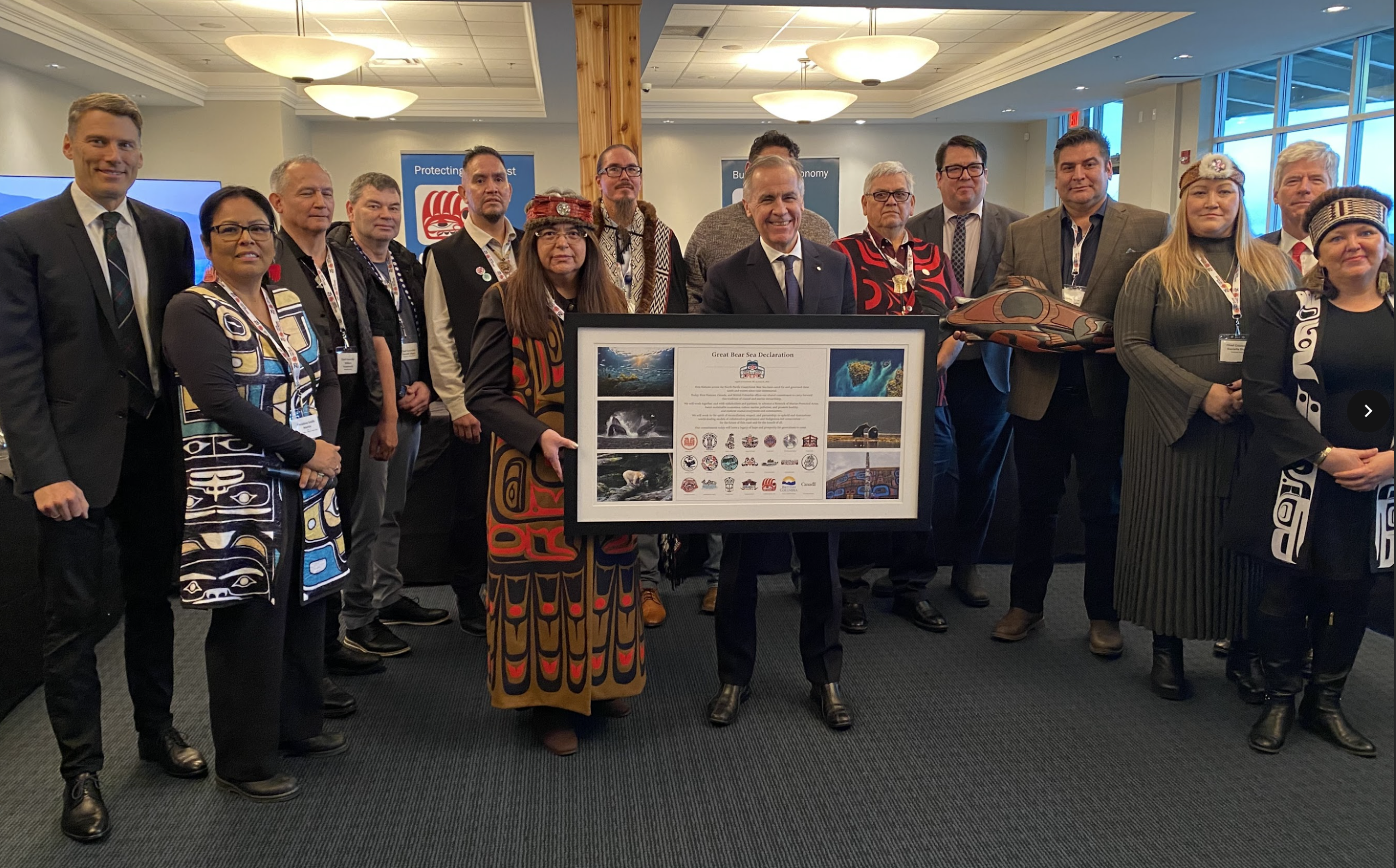
Prime Minister Mark Carney met with Coastal First Nations leadership in Prince Rupert this week, following months of political tension over proposed energy development and the federal oil tanker ban on British Columbia’s North Coast.
The meeting came after Coastal First Nations chiefs publicly called for talks in December, after which Carney said his office formally requested a face-to-face meeting “at the earliest opportunity.”
That commitment followed a unanimous resolution from chiefs urging Ottawa to withdraw from a memorandum of understanding signed with Alberta in late November that opened the door to potential new pipeline development and possible exemptions to the tanker ban.
Speaking after the meeting, Coastal First Nations President Marilyn Slett said the alliance invited Carney to the region to ensure Indigenous governments are directly involved in decisions affecting their territories.
“This morning, our Coastal First Nations communities invited the prime minister here,” Slett said. “Anytime there is a discussion about our territories, we need to be in the room, and it is very important to us that the prime minister see our territories and understand our concerns.”
Slett said Carney told the delegation his government would seek free, prior and informed consent on any proposed projects affecting their territories and would co-develop a transparent decision-making process with First Nations moving forward.
She said Coastal First Nations reiterated their opposition to oil pipelines and tanker traffic on the North Coast.
“Our position has not changed,” Slett said. “Coastal First Nations, along with Lax Kw’alaams and the Haida Nation, oppose any project that proposes to bring oil tankers to the North Coast.”
She said the alliance emphasized that a single spill could permanently damage coastal ecosystems and communities.
“There is no technology that can clean up an oil spill at sea. It would take just one spill to destroy our way of life,” she said.
Slett also described the oil tanker ban as the result of 15 years of consultation with coastal communities, calling it foundational to protecting both the environment and the regional economy.
Gaagwiis Jason Alsop, president of the Council of the Haida Nation and vice-president of Coastal First Nations, focused his remarks on the economic reality of coastal communities and the growing risks tied to marine traffic.
“Our coastal economy is already an important economic driver in this area, worth billions of dollars, and is continuing to grow,” Alsop said.
He said the coastal economy contributes more than $3 billion annually and employs about 30 per cent of the workforce on the North Coast, including many jobs in Prince Rupert.
Alsop warned that proposed projects, including LNG expansion and critical minerals development, would significantly increase shipping traffic along the coast.
“Each one of those proposals and potential projects has a significant impact on adding to the shipping traffic here on the North Pacific coast,” he said. “We need to make sure that the impacts on species, habitat, coastal erosion, our communities and our culture are factored into every decision.”
He said coastal nations would be the first to respond to any marine disaster.
“Our communities are the ones that are impacted by this proposed increase in shipping and projects. We’re the first responders,” he said, pointing to past incidents including the sinking of the Queen of the North, the Nathan E. Stewart fuel spill and the near-grounding of the Simushir.
“The message is clear. We’re not ready. The coast is not ready right now to respond to accidents and emergencies,” Alsop said. “It takes days to respond, and we know the adverse conditions here of weather and tides.”
He said Coastal First Nations estimate shipping traffic could increase by 217 per cent in coming years, underscoring the need for training, equipment and emergency response capacity in coastal communities.
Following the meeting, Carney’s office said discussions focused on strengthening marine conservation, ocean protection and building a sustainable coastal economy in partnership with Coastal First Nations.
In a written statement, the Prime Minister’s Office said Canada is facing growing global and economic pressures.
“Our country is under threat, putting our economy, our sovereignty, and our way of life at risk,” the statement said. “As a maritime nation, safeguarding our oceans and coastlines is not just a moral obligation. It is an economic necessity.”
The federal government said Carney committed to renewing funding for the Oceans Protection Plan Reconciliation Framework Agreement in 2026–27 and directed ministers to work with partners to present a five-year funding pathway by this spring.
Ottawa also reaffirmed its commitment to conserving 30 per cent of Canada’s land and waters by 2030, including new marine protected areas in the Great Bear Sea, and announced funding for a marine traffic risk assessment, extended leases for emergency towing vessels until 2028, and measures to ensure towing capacity matches shipping activity.