I once heard a story about a goddess named Artemis. As the goddess of the hunt, wild animals and archery, she was known to be the best archer of all the beings in all the worlds. None could rival her impeccable aim or the strength with which she shot her arrows.
Yet one mortal, a giant among men, was skilled enough to almost match her prowess. This fellow hunter was named Orion, and he became Artemis’ hunting companion.
One day, Artemis’ twin brother Apollo became frustrated with her involvement with a mortal man. Apollo was a great marksman himself, and perhaps envied that a mere mortal was hunting with the skill of a god. He made a bet with Artemis, saying that she could not possibly strike a tiny, almost imperceptible speck on the horizon.
Artemis scoffed, drew back her bow, and fired an arrow, immediately striking the speck despite it being miles away.
Together, they ventured to that distant spot, and it turned out to be her friend whom she had shot and killed. Artemis wept, letting out a harrowing cry of sorrow. She decided to lift his spirit into the heavens, immortalizing him in the form of the Orion constellation.
Another version of this story claims that Orion boasted he would kill all the animals on Earth. Gaia, the mother goddess of the Earth, sent a scorpion to kill him for his blatant disrespect to nature. She uplifted both the scorpion and the hunter into the sky as a warning to all not to disrespect the natural world. The scorpion became the constellation Scorpius, one of the zodiacal constellations.
This myth of Orion is just one of hundreds of stories about this constellation found across the world. Many cultures interpret the constellation as a hunter chasing the seven sisters of the Pleiades. The theory goes that since Indigenous Australians tell a version of this hunter story, and their migration to Australia occurred around 60,000 years ago, it is one of the oldest known stories linking many cultures across the world.
Another theory I have heard is that during meteor showers, shooting stars can appear to shoot out from this hunter, appearing as celestial arrows streaking across the heavens.
A story from the northwest coast, from Kwakwaka’wakw territory, says he is a harpooner hunting an otter in the form of the Pleiades. Many European stories see him as a giant of some kind, while others have seen him as a god, such as Osiris from ancient Egypt. Some stories interpret these stars as a turtle, or combine them with other bright stars to form different animals.
Orion is one of the most well-known constellations around the world. The image within the stars is easy to see. The belt forms an easily recognizable asterism, its bright stars feature in the winter night sky in the northern hemisphere, and the stars within the constellation reveal fascinating scientific phenomena.
When and where is Orion visible?
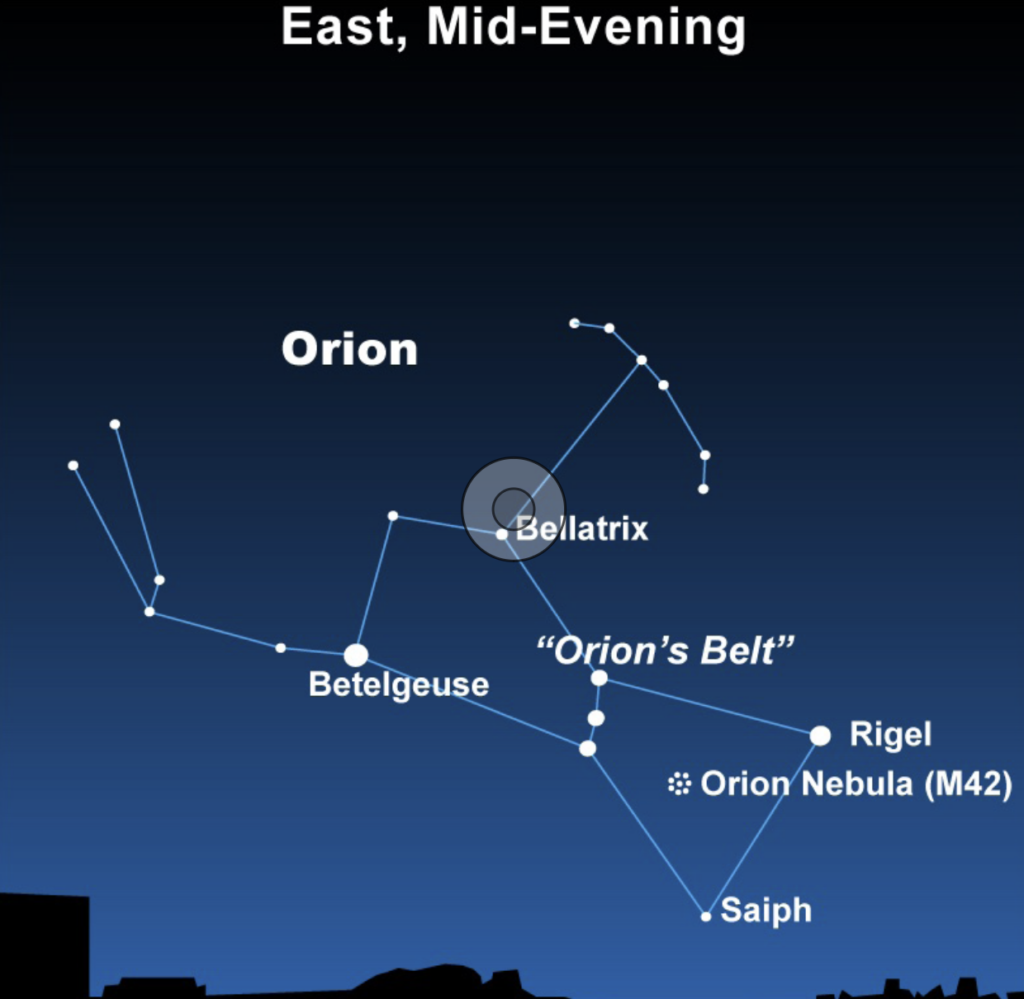
Orion can be found beneath the ecliptic plane. It becomes increasingly visible in the winter months, rising in the east at our latitude during winter evenings and crossing the southern sky into the west. The winter sky is much darker than the summer, so the stars shine more brilliantly, imparting a great magnificence upon us.
At midnight on Feb. 1, Orion will be in the southwest sky.
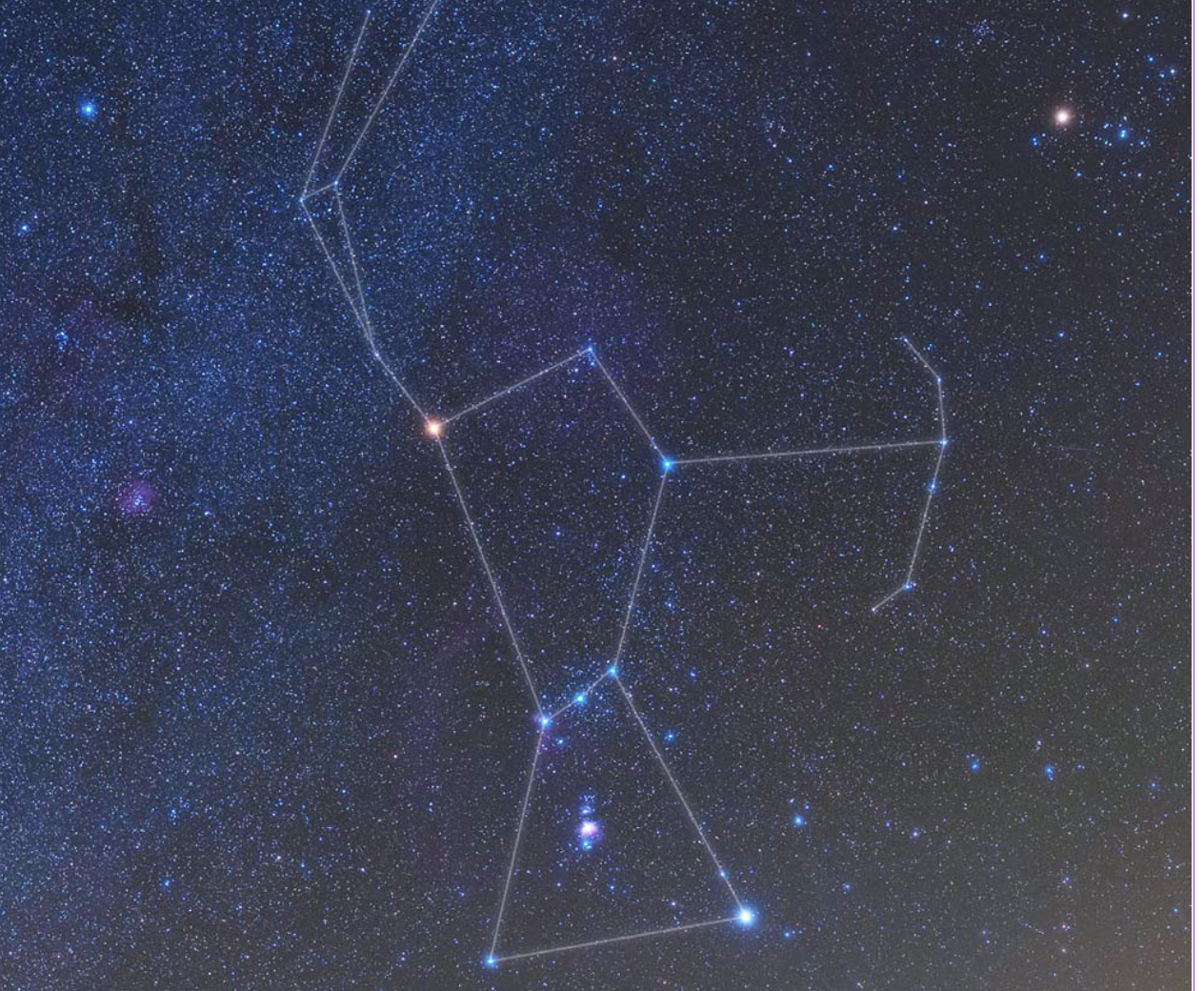
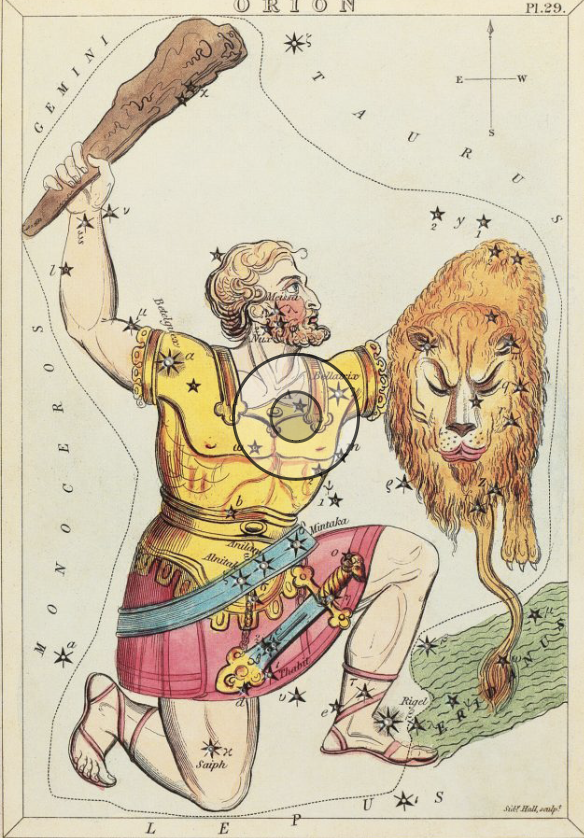
Orion is often depicted as a man kneeling. His torso is clear to see, his belt hangs brightly, and his legs are shorter as they are bent. He holds one hand upward, either drawing back an arrow or raising a club. Outstretched toward the west is a crescent of stars, often represented as a bow, a hide from his recent quarry, or a shield raised in protection.
The stars Betelgeuse (pronounced “Beetlejuice”) and Bellatrix form his shoulders. Betelgeuse is the brighter of the two and has a reddish-orange hue. It is a red supergiant star at an estimated distance of 497 light-years.
In 2019 it dimmed significantly, leading to theories about it going supernova. It may do so one day, but perhaps not for another 100,000 years.
The iconic belt consists of three stars: Alnitak, Alnilam and Mintaka. Alnitak is a three-star system. Alnilam is a singular blue supergiant star. Mintaka is a quintuple star system.
This means the three stars we see actually consist of nine stars, and possibly more.
Orion’s Belt is technically considered an asterism, not a constellation. There are 88 officially recognized constellations in the modern star classification system. Groupings of stars like Orion’s Belt, or formations such as the Winter Hexagon that span multiple constellations, are called asterisms.
Beneath the belt hangs his hunting knife, which contains the Orion Nebula, also known as Messier 42. The middle star in his blade is actually this nebulous region, a birthplace for stars. It is approximately 25 light-years across and is easily observed through binoculars or small telescopes.
The final two notable stars in Orion make up his lower limbs. Saiph is the dimmer of the pair, found on the left side of his body. Saiph, or saif, is an Arabic word for sword.
On the right side is Rigel, pronounced like the name Nigel but with an R. It is usually the brightest star in the constellation. This blue supergiant star is approximately 850 light-years away and is calculated to be at least 61,000 times more luminous than the sun.
The old adage that the brightest stars burn the fastest rings true here. Supergiant stars burn through their cores much quicker than smaller stars like our sun. They burn for millions of years, as opposed to the billions of years our sun will shine.
Astronomers expect Rigel to eventually go supernova, leaving behind a neutron star or a black hole.
Orion will thankfully continue to shine brightly for us and can be a starry companion on winter nights. He has become an old friend to me. I have seen him shining for two decades now and look forward to enjoying many more decades of his light.
May the starlight of the hunter guide you in the night,