There are days when my mind wanders.
There are days when, like I know it is for many, that feeling of anxiety seems to accompany my every move.
There are bad days and there are good days, and there is also the reality of life and the challenges it will present to us, no matter what our state of mind might be.
During those days, but really every day, I try to remember the practices that bring calmness to my mind and help me connect with my body.
I enjoy a cold shower every morning to help my body awaken. As I endure the initial discomfort, I finally relax into a calmer and more present version of myself, even if for just a few minutes.
I am also grateful for a place like George Brown, where Desi welcomes many of us to play soccer in between basketball practices, moving our bodies and working up a good sweat.
Music also plays a big role in how I feel.
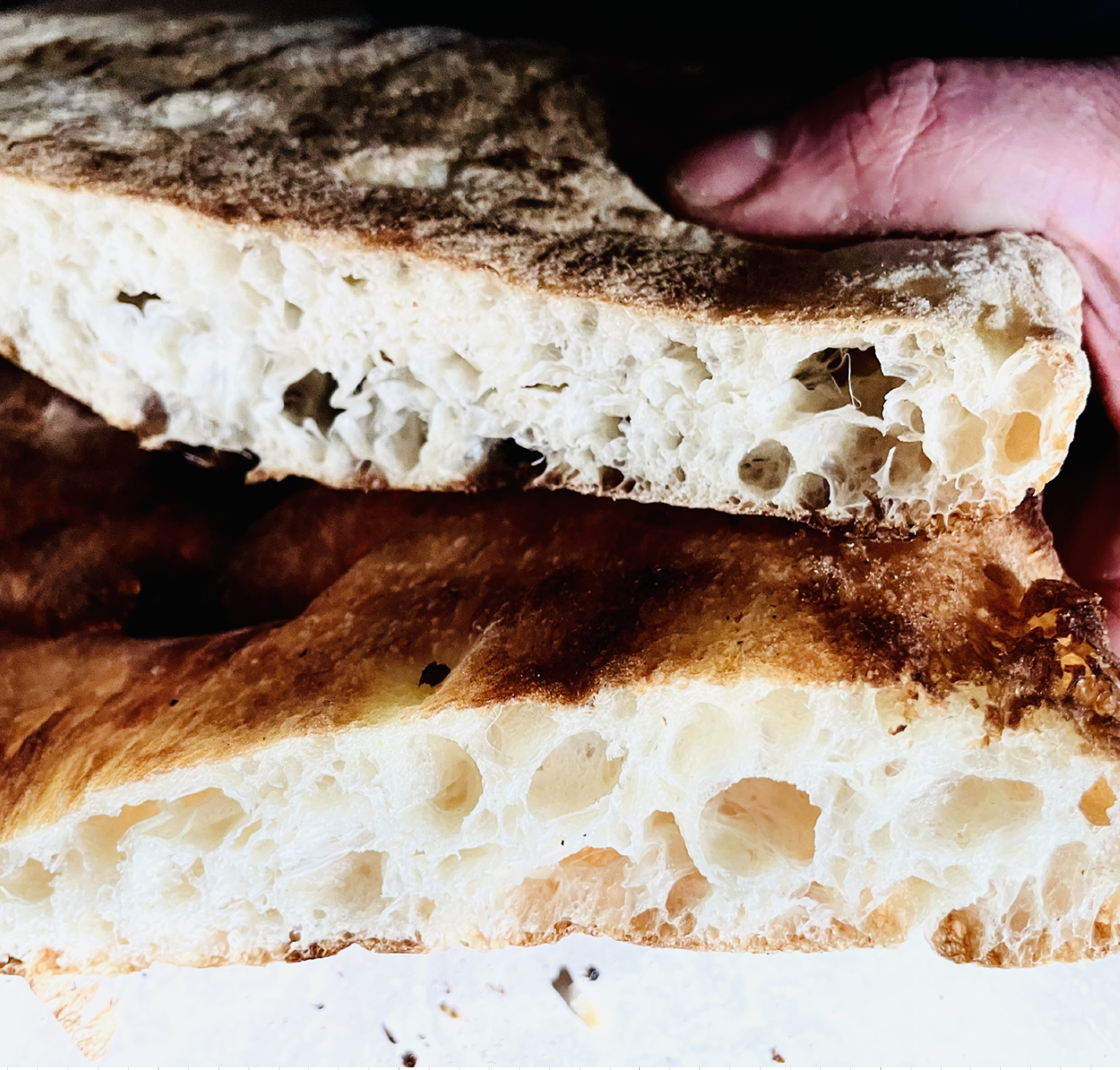
But more than anything, I know I find my sanity best when pressing my fingers into a chunk of dough, filled to the brim with air. As I stretch it to its final size, I am reminded of the role that food has in my life. I feel grateful that I get to do this every day, and I feel happy and present when I do.
Making focaccia is the perfect example.
We make focaccia by hand at the restaurant, without the use of any machinery, not just as a matter of practicality. The process is that simple and requires just a little attention, aside from the ingredients listed in the recipe.
So let’s make it together.
Gather’s Focaccia
850 g lukewarm water (27 C to 37 C)
23 g salt
3 tbsp olive oil
13 g active dry yeast
700 g bread flour
200 g 00 flour
100 g whole grain flour (einkorn, spelt, wheat)
I start by weighing all the dry ingredients and placing them in a bin.
Then it’s time for the water, hot from the kitchen faucet. I add the yeast to it, along with the olive oil.
While the yeast activates and starts to foam up, I give a good shake to the bin with the flours and salt before adding my liquids to it. “Don’t rush things,” a teacher once told me. “Don’t be a slave of time.” A golden rule for both baking and life.
With one hand, I hold my container steady, while with the other I go around and around until everything is well mixed together. It’s meant to feel and look like a big mess, but what I am really making sure of is that there are no dry bits of flour hiding anywhere.
Then I let it sit, covered, for half an hour.
The dough is high hydration, so I always make sure my hands are wet before I start handling it. This limits the amount of goop sticking to random things on and around me. I stretch and fold the dough four times in total, with intervals of half an hour in between.
I stretch and fold the dough by reaching underneath the mass, grabbing firmly but gently, and pulling a limb up over onto itself. I then rotate the bin 45 degrees and repeat the operation three more times to go all the way around. A quick internet search may also be helpful for visual learners.
With each repetition, the dough grows in mass and structure as it fills with air. I am mindful to be increasingly gentle as I reach the final set.
At the end of the fourth set, I let the dough rest, covered, for about two hours, or until it has more than doubled in size. Please take the two hour mark as you would interpret a speed limit sign. Be mindful of it, but remember that a lot will depend on variables like the specific temperature of your water and the room. Just don’t be a slave of time.
I know the dough is ready when it jiggles so hard that it forces a smile on my face. That’s how I also know the process is working.
I flip the bin onto a well oiled pan and, with my hands wet, gently stretch the dough to fit the pan. I am not worried if it doesn’t quite reach its borders. I am just suggesting what it should be doing.
Now comes a generous gulp of olive oil over the top, as well as all over my hands, and I start creating focaccia’s iconic dimples by pressing the dough from bottom to top, gently but firmly, with the tips of my fingers, with the goal of stretching it to its final size. If the dough is acting shy, retracting after each pull, I let it sit for 10 to 15 minutes. You need to strike a balance between the dough reaching its final shape and how much you are handling it. Generally speaking, less is more.
I like to top my focaccia with good oregano and flaky salt, but you are the chef in your own kitchen, so have fun.
After one last proof of about one hour, ideally in a warm place, the focaccia is ready for the oven. Bake at 420 F for about 20 to 23 minutes, until golden on top. As always, use your best judgment to adjust as needed.
As the sweet smell of rising dough fills the kitchen, I am smiling, knowing what’s about to come.
I pull the pan out of the oven and rest the focaccia on a cookie sheet to ensure proper air flow underneath, and, in theory, to allow it to fully cool before I dig in.
But it’s too late. I am already eating it.