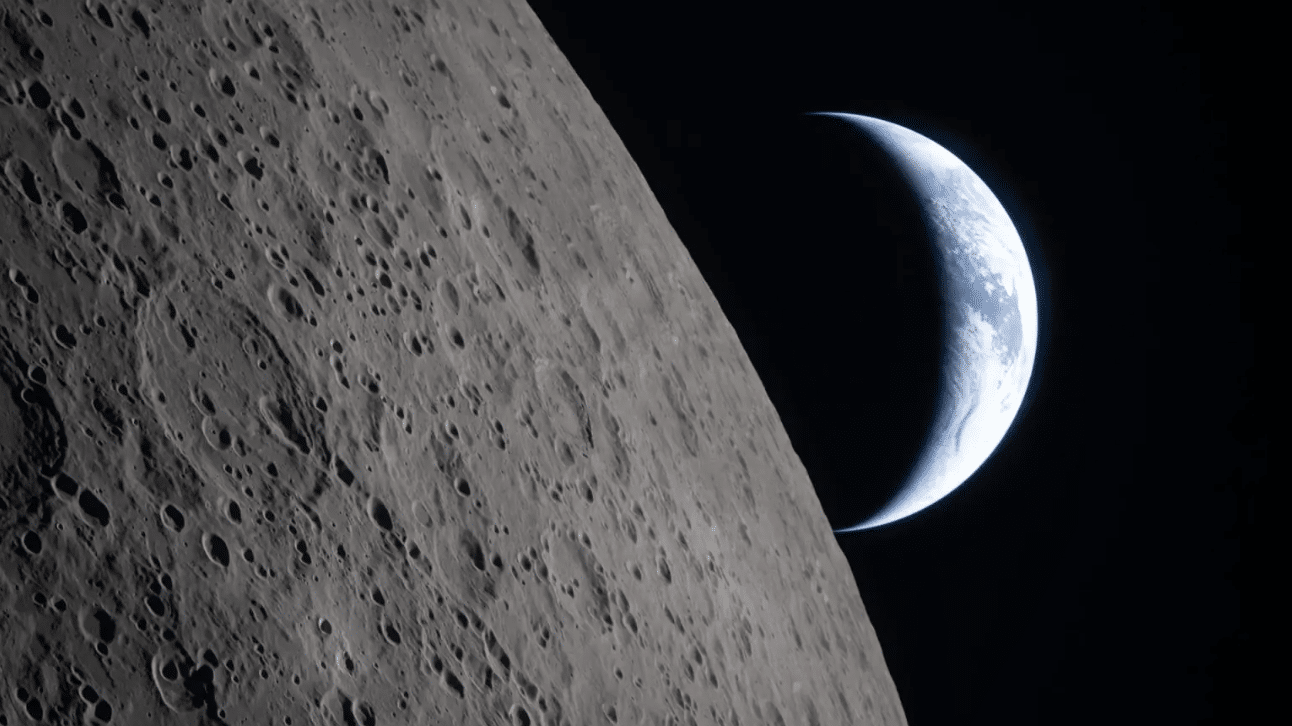
A Canadian astronaut is part of a historic return to deep space, as humans once again circle the Moon for the first time in more than 50 years.
Jeremy Hansen is among four crew members aboard Artemis II, marking the first time a Canadian has travelled beyond low Earth orbit. The mission is a major milestone not only for NASA, but for Canada’s role in future lunar exploration.
Four astronauts aboard Artemis II have travelled farther from Earth than any humans in history, marking a return to deep space not seen since the Apollo era.
According to NASA, the crew reached a maximum distance of 252,756 miles (406,606 kilometres) from Earth during an April 6 lunar flyby, surpassing the record set during the Apollo 13 mission.
The spacecraft passed within roughly 4,000 miles (about 6,400 kilometres) of the Moon’s surface before continuing along a free-return trajectory back toward Earth, a path designed to bring the crew safely home without the need for major course corrections.
During the flyby, the spacecraft moved behind the Moon for about 40 minutes, cutting off all communication with Earth. For that stretch, the crew experienced complete silence as the Moon blocked both radio signals and any direct view of home.
Canadian astronaut Chris Hadfield reflected on the moment in a social media post April 6.
“Four people are flying around that Moon today,” he wrote. “The first since 1972, and the first-ever with digital cameras, to see better into the dark craters and textures.”
He also pointed to the quiet isolation of deep space.
“The crew will have perfect quiet when the Moon blocks out Earth, a time of peace, alone, together.”
The mission is a reminder of how far human spaceflight has shifted.
Artemis II is not a landing, but a test of the systems needed to go farther and stay longer. It is the first real step beyond low Earth orbit in more than 50 years.
After decades of circling close to home, humans are moving outward again, this time with the goal of building something that lasts.
The mission is also testing critical systems for future flights, including life support, navigation, communication and the Orion spacecraft’s performance in deep space. These systems will be essential for upcoming missions that aim to place astronauts on the lunar surface.
The work behind this mission has taken years.
Unlike the Apollo program, which was driven by urgency and geopolitical competition, Artemis is built around long-term planning and international cooperation. The goal is not just to reach the Moon again, but to stay, with future missions aimed at establishing a sustained human presence.
A key part of that plan is the Lunar Gateway, a small space station that will orbit the Moon and serve as a staging point for missions to the surface and beyond. The Gateway is designed to support longer stays, allow for international crews, and act as a hub for both scientific research and future exploration deeper into space.
Canada is playing a central role in that next phase.
The Canadian Space Agency is contributing robotics and technology to the program, including Canadarm3, which will operate on the Gateway and help maintain the station and support visiting spacecraft.
As of press time, the mission is more than halfway complete, with splashdown expected April 10 off the coast of San Diego.