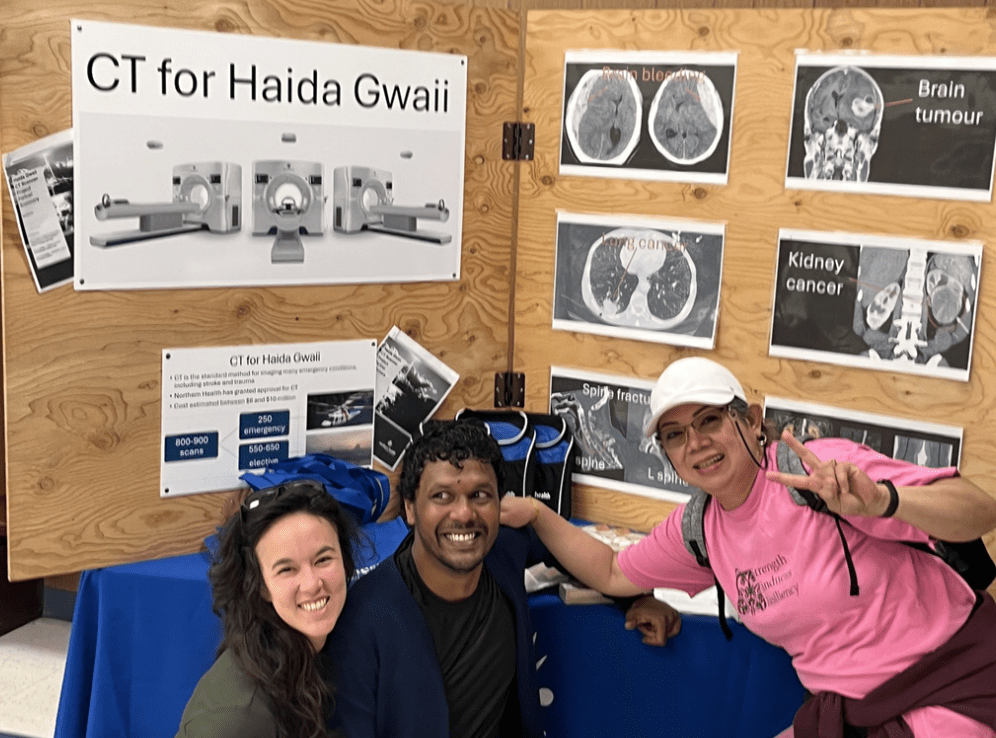
For many on Haida Gwaii, a computed tomography (CT) scan is not a quick appointment. It is a three-day trip off island, a ferry or a flight, a hotel, meal costs and a gamble with weather. It is also a race against time for conditions like stroke, where a scan is needed before life-saving treatment can start.
New data compiled by local physicians shows the scale of that burden. From January 1, 2019 to December 31, 2024, residents made 2,497 trips to Prince Rupert or Terrace for CT scans. Of those, 362 were urgent transfers by BC Emergency Health Services (BCEHS). Another 2,135 were routine outpatients who travelled on their own. On average, 416 islanders leave each year for a scan.
The numbers sit inside a larger inequity. Haida Gwaii residents receive 133 CT scans per 1,000 people each year. The provincial rate is 180 per 1,000. Physicians say the gap translates into delays, missed diagnoses and added risk for elders and people with chronic illness. Their audit also found that about half of the scans were for Indigenous patients.
Why it matters is clear in stroke care. About 85 per cent of strokes are caused by a clot. Patients can receive drugs that open blocked vessels, but only after a CT scan rules out bleeding. Without a scanner on island, stroke patients must be stabilized and flown before treatment can begin.
Local doctors have built a business case to bring a scanner to Haida Gwaii. They estimate between 800 and 900 scans per year once service is in place, approaching the provincial average. They project a 40 per cent drop in urgent transfers because more patients could be assessed and treated locally. They estimate overall system savings of $350,000 to $400,000 a year through fewer air-ambulance transfers and lower travel subsidies.
Travel costs add up quickly for routine trips. The provincial Travel Assistance Program covers fares at reduced rates, but not everything. A regular vehicle on BC Ferries between Haida Gwaii and Prince Rupert is $130 one way. A resident fare is $36.55 per person one way. An inside cabin is $135 and is not covered. A seat on Inland Air Seaplanes is $331.15 each way. The average medical trip runs three days. A conservative daily estimate is $259 for one person, based on a $185 hotel and the Canada Revenue Agency meal rate of $69 per day.
Physicians say the capital cost to renovate and install a CT scanner on island is at least $6.1 million, and could be higher. A separate estimate in their planning documents places the range between $6 million and $10 million, depending on the site and renovations. Under the model being advanced, the capital build would be 100 per cent fundraised locally. The Village of Port Clements has already pledged $100,000 toward the scanner. Once built, Northern Health would operate the service.
Northern Health provided written responses to Haida Gwaii News about how the authority plans and funds new diagnostic services, and what the road ahead could look like for Haida Gwaii.
On how sites are chosen, Northern Health says it uses a diagnostic strategy that forecasts future patient demand and models a community’s capacity to support the service. Staffing and other resources are part of that planning. The strategy was recently updated and applies to small, remote and Indigenous communities.
On funding timelines, Northern Health says capital fundraising can run over multiple years. That aligns with the reality that it often takes years to move from early planning to actual service. Campaigns can continue while capital planning and approvals progress. The authority notes that operating a CT scanner can cost more than $1 million per year. Those operating costs are funded within Northern Health’s operating budget through Ministry of Health funding. That figure is higher than the $300,000 annual operating cost estimated by local physicians in their business case. The physician’s estimate includes a service contract, one additional technologist and supplies. The authority’s figure reflects broader ongoing costs in the regional system.
On staffing, Northern Health says that in communities where a new service is being considered, it invests in training for current staff who want to build new skills. Recruitment and training begin early to prepare for new or expanded services. The authority continues to develop locum and remote capacity to support diagnostic imaging when needed.
“In communities where a new service may be introduced, we initiate several steps to invest in training for current staff who may be interested in developing new skills, and we begin a recruitment and training process early to prepare for eventual service implementation or expansions. We also continue to develop locum and remote capacity to support services, as needed,” said Eryn Collins, regional director of public affairs and media relations for Northern Health.
On partnerships, Northern Health points to the current effort on Haida Gwaii as a strong example of community leadership. The partners named for this project are Haida Gwaii physicians, the Hospital Day Foundation, Gwaii Trust Society, the North Coast Regional Hospital District, Old Massett and Skidegate Band Councils, the communities of Haida Gwaii and the Spirit of the North Foundation. The authority also works closely with the First Nations Health Authority across the North on many services, including on Haida Gwaii.
On operations and timeline, Northern Health says a Haida Gwaii scanner would be part of its existing diagnostic imaging services on island. There is no firm timeline yet for decisions on location, staffing or a start date. The authority says it will work with partners and keep communities informed as planning continues.
On short-term measures, Northern Health says it continues to explore ways to improve access where possible. That includes increasing virtual access to care and looking at how technology, including artificial intelligence, could change how services are delivered in future.
Where the scanner would sit is not yet decided. Early concepts have focused on adding CT inside the diagnostic imaging footprint at Haida Gwaii Hospital & Health Centre in Daajing Giids. The physicians’ planning notes say two retrofit options have been sketched for that site. Feasibility work for Northern Haida Gwaii Hospital in Masset has not been completed. Adding CT would also require another imaging technologist. Today, each hospital has one technologist on scheduled days with on-call coverage at night and on weekends. Physicians argue that a third technologist would make the workload more sustainable and improve reliability for plain X-ray services.
The project is in what the physician group calls Phase 2. Northern Health has completed early feasibility work. The next step is confirming capital funding with partners. If full funding cannot be confirmed in a single fiscal year, organizers say they will move to a multi-year approach.
Behind the numbers are the people most affected by long waits and long trips. Cancer patients who need repeated scans. Elders who cannot manage a rough crossing without an escort. Families who must take time off work to travel with a parent or child. The business case argues that local access to CT would reduce delays, improve trust in local care and help recruit and retain health professionals who are trained in environments where CT is part of standard practice.
Community members can follow updates through local partners as the planning and fundraising continue. Northern Health says it will share more information as milestones are reached.

